The best professional fluid transfer pumps offer safe handling, steady flow, easy use, and reliable fluid control.
Changing oil, filling a transmission, or moving fuel can get messy fast. In a busy American auto shop, every spill wastes time and makes more work. The right pump helps move fluid with less effort and better control. I compared these ten options by their listed design, power source, capacity, and intended use. This guide covers electric, air-powered, hand-operated, and siphon pumps. These are product-based reviews, not claims of hands-on testing. Always check the maker’s fluid and safety ratings before use.
🏆 Top 3 Products

BILITOOLS 8L(2.1 gal) Transmission Fluid Pump Air Operated, 15 ATF adapters | Fluid Transfer Pump Automotive, Pneumatic Vacuum Oil Fluid Extractor Dispenser, ATF Refill Kit
Its 8-liter tank, air-powered design, and 15 ATF adapters make it a strong choice for regular automotive fluid service.

Faitio Oil Pump 12V 100W, Oil Extractor Pump for DIY Engine Oil Change | Electric Fluid Transfer Pump for Synthetic, Gear Oil, Trans Fluid Removal, Self-Priming Oil Transfer Pump for Car, Mower,Boat
Its 12V power, 100W rating, and self-priming design suit many routine oil removal jobs.

Slippery Pete Fluid Pump for Gallon Bottles and Wide Mouth Quart Bottles (Not for Standard Quart Bottles) – Transfer Gear Oil, Transmission and Differential Fluid, Antifreeze with This 30cc Hand Pump
Its 30cc hand-stroke design offers simple fluid transfer without a battery, air line, or electric motor.
Faitio 12V Oil Transfer Pump Review
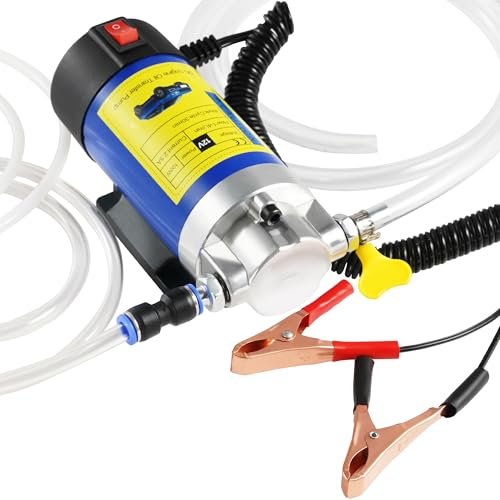
The Faitio 12V oil pump is made for people who want an electric way to move oil. It has a listed power rating of 100 watts and uses a 12V power source. Its self-priming design aims to help start fluid movement without the same effort as a hand pump. This makes it worth a look for home garages and light service work.
The product title lists engine oil, synthetic oil, gear oil, and transmission fluid removal as its main uses. It also names cars, mowers, and boats as possible applications. I like the range of jobs this design aims to cover. Still, fluid thickness, hose size, temperature, and pump material can affect results, so I would check the full maker instructions before each new use.
✅ Pros
- ✔ Runs on a 12V power source for use with a suitable vehicle or power supply.
- ✔ The 100W rating gives buyers a clear power figure to compare.
- ✔ Self-priming design can make the start of a transfer easier.
- ✔ Made for oil removal during routine engine service.
- ✔ Lists synthetic oil, gear oil, and transmission fluid among its intended uses.
- ✔ Can suit several types of equipment, including cars, mowers, and boats.
- ✔ Electric operation can reduce repeated hand pumping during longer jobs.
⚠️ Cons
- ✖ Needs a suitable 12V power source to run.
- ✖ The listed title does not state an exact flow rate.
- ✖ Very thick or cold oil may move more slowly.
- ✖ Buyers must check hose size and fluid limits before use.
My Recommendation
I would consider the Faitio for a home garage or a small service area that handles regular oil changes. Its 12V setup gives it a clear role, while its self-priming design may save effort during fluid removal. It is also a useful option for people who service more than one type of machine. I would not treat it as a universal fuel pump or a full shop fluid station. Check its exact fluid limits, duty cycle, hose setup, and power needs first. Among the Best Professional Fluid Transfer Pumps, this one stands out for users who want electric oil removal in a compact setup.
| Best For | Why |
|---|---|
| Home oil changes | Its 12V electric design can reduce the effort of routine oil removal. |
| Mower and boat owners | The listing names mowers and boats as intended uses. |
| Small garages | It offers powered oil transfer without the need for a large shop system. |
TIGEROAR 18 GPM Fuel Transfer Pump Review

The TIGEROAR pump is a 110V electric transfer pump made for fuel movement. Its listed flow rate is 18 gallons per minute. That figure makes it a more suitable candidate for bulk transfer than a small hand-operated bottle pump. The design may appeal to farms, workshops, and other sites that move fuel on a regular basis.
The product title lists diesel, kerosene, biodiesel, and light oil as supported fluid types. It also mentions fuel filling and oil draining. I would pay close attention to the exact fuel rating before connecting this pump to a tank. Never assume that a diesel or kerosene pump can safely handle gasoline, since gasoline needs equipment with the right safety rating and design.
✅ Pros
- ✔ The 110V electric design suits locations with a compatible power supply.
- ✔ The listed 18 GPM rate targets faster bulk fluid movement.
- ✔ Designed for fuel transfer rather than only small bottle refills.
- ✔ Lists diesel as an intended fluid type.
- ✔ Lists kerosene and biodiesel among its stated applications.
- ✔ Can suit fuel filling and oil draining tasks.
- ✔ May reduce the time needed for larger transfer jobs.
⚠️ Cons
- ✖ Needs a suitable 110V electrical supply.
- ✖ Its larger flow rate may be excessive for small service jobs.
- ✖ The title does not list an exact duty cycle or lift height.
- ✖ Gasoline use must not be assumed without a clear maker rating.
- ✖ Fuel transfer needs proper grounding, ventilation, and fire safety.
My Recommendation
I would place the TIGEROAR high on the list for people who move larger amounts of approved fuel. Its 18 GPM listed rate is its main selling point. A farm, diesel equipment service area, or workshop may benefit more from this format than from a small hand pump. It is not my first choice for slow, precise transmission filling. Before buying, check the exact inlet and outlet size, power needs, duty cycle, fuel approval, and required safety steps. For the Best Professional Fluid Transfer Pumps, this model is worth considering when speed and approved fuel handling matter most.
| Best For | Why |
|---|---|
| Diesel equipment users | The product title lists diesel as a supported fluid. |
| Farm fuel transfer | Its 18 GPM rating may help with larger transfer jobs. |
| Workshop fuel stations | The 110V electric format suits a fixed setup with approved power and fuel safety. |
8cc Quart-Bottle Transmission Fluid Pump

This manual fluid pump is made for standard quart bottles. It moves about 8cc of fluid with each pump stroke, based on the product title. It also includes a third-hand adapter to help keep the bottle and pump in place during use. This design focuses on controlled filling instead of fast bulk transfer.
The listed uses include transmission and differential fluid. Those jobs can be awkward because fill ports are often hard to reach. A bottle-mounted pump can help move fluid into a tight space with less lifting and pouring. I would check the bottle neck size and adapter fit before ordering, since a poor fit can lead to leaks and wasted fluid.
✅ Pros
- ✔ Designed to fit standard quart fluid bottles.
- ✔ Moves a listed 8cc with each pump stroke.
- ✔ Manual operation does not need electricity or compressed air.
- ✔ Includes a third-hand adapter for added bottle support.
- ✔ Made for transmission fluid transfer.
- ✔ Can also serve differential fluid filling tasks.
- ✔ Small strokes can help control the amount of fluid added.
- ✔ A simple design can be easy to store in a tool drawer.
⚠️ Cons
- ✖ The 8cc stroke can make large fills take more time.
- ✖ It depends on a compatible standard quart bottle.
- ✖ The adapter may not fit every bottle or fill port.
- ✖ Manual pumping needs repeated effort during long jobs.
My Recommendation
I would choose this pump for small, careful transmission and differential fluid jobs. Its main benefit is the bottle fit and the 8cc stroke size. The third-hand adapter may also help when a fill port is in a hard spot. It is not designed to replace a high-volume transfer system. If you service many vehicles each day, a larger pneumatic pump may save more time. For a home mechanic, this is one of the more focused Best Professional Fluid Transfer Pumps because it aims at common quart-bottle service work.
| Best For | Why |
|---|---|
| Transmission service | Its stated design targets transmission fluid transfer. |
| Differential filling | It is also listed for differential fluid. |
| Small garages | The manual format is simple and does not need a power source. |
3 GPM Manual Fuel Siphon Pump Review

This manual fuel transfer pump offers a portable way to move liquid from one container to another. Its listed flow rate is up to 3 gallons per minute. The hand-operated design does not need a wall outlet or an air compressor. That can make it handy for field work, farm equipment, and basic garage tasks.
The product title lists gasoline, water, transmission fluid, diesel, and oil as possible uses. These fluids do not all have the same safety needs. I would only use the pump with a fluid that the maker clearly approves for its materials and design. In particular, gasoline needs a pump rated for that fuel and its fire risks. The 3 GPM claim should also be treated as a stated maximum, not a promise for every liquid.
✅ Pros
- ✔ The manual design works without a power outlet.
- ✔ Lists a flow rate of up to 3 GPM.
- ✔ Portable format can suit field and farm use.
- ✔ Can be stored without a large power unit.
- ✔ The product title lists several intended fluid types.
- ✔ Can help move fluid between suitable containers.
- ✔ Simple hand operation may suit occasional transfer jobs.
⚠️ Cons
- ✖ Manual operation may tire the user during large transfers.
- ✖ The actual flow rate can change with fluid and setup.
- ✖ The title does not give a detailed material compatibility chart.
- ✖ Gasoline use requires clear fuel approval and safe equipment.
- ✖ It may not suit frequent high-volume shop work.
My Recommendation
I would consider this model for occasional fluid movement where a powered pump is not needed. Its 3 GPM claim gives buyers a useful figure to compare, while its hand-operated design keeps the setup simple. It may suit a farm shed, home garage, or emergency equipment kit. However, I would not use a general siphon pump for every fluid named in a broad listing without checking the maker’s full safety guide. Confirm the material, hose length, flow direction, and fuel rating first. This pump can earn a place among the Best Professional Fluid Transfer Pumps for basic portable tasks, but it is not a full shop-grade fuel system.
| Best For | Why |
|---|---|
| Farm equipment owners | Its portable hand design can suit work away from a fixed shop. |
| Occasional transfers | It avoids the need for electric or air power. |
| Basic garage use | The listed 3 GPM rate offers a useful starting point for small jobs. |
LOZAGU Multi-Use Siphon Pump Review

The LOZAGU siphon pump is a multi-use tool for moving liquids. Its design aims to make fluid transfer simple without a powered motor. This can help people who need a portable tool for a home garage, yard, or work area. The product title lists a kit format, which may appeal to buyers who want a basic transfer setup in one purchase.
The listing names gas, oil, and other liquids as possible uses. That broad wording makes it important to check the exact materials and approved fluids before use. A pump that works with water may not be safe for fuel or harsh chemicals. I would also check the hose length, connection style, and method used to start the siphon. These details matter more than a broad multi-use claim.
✅ Pros
- ✔ Manual siphon design does not need electricity.
- ✔ Portable format can fit in a garage or vehicle kit.
- ✔ The product title lists gas and oil transfer uses.
- ✔ Kit format may offer a ready-to-use basic setup.
- ✔ Can help move suitable liquids between containers.
- ✔ Simple operation may suit people with basic tool skills.
- ✔ No motor means fewer powered parts to manage.
⚠️ Cons
- ✖ The listing title does not state a clear flow rate.
- ✖ Manual siphon action may take time with large amounts.
- ✖ Exact fluid and material compatibility needs confirmation.
- ✖ It may not provide the control needed for precise transmission fills.
- ✖ Fuel use requires a suitable approved pump and safe work area.
My Recommendation
I would look at the LOZAGU for simple, occasional fluid transfer rather than daily professional work. Its main appeal is its basic siphon format and multi-use focus. It may suit a home garage where the user needs to move a small amount of an approved liquid now and then. The lack of a stated flow rate makes it harder to compare with electric and higher-capacity pumps. Before buying, check what comes in the kit and which fluids the maker approves. It is a practical option to compare with other Best Professional Fluid Transfer Pumps if portability matters more than speed.
| Best For | Why |
|---|---|
| Home garage users | Its manual design offers a simple option for occasional fluid transfer. |
| Basic liquid movement | The kit is listed for oil and other suitable liquids. |
| Portable tool kits | It does not need a fixed electrical or air supply. |
BILITOOLS 8L Pneumatic ATF Pump Review
The BILITOOLS fluid transfer kit is built for automotive transmission service. It has an 8-liter tank, which equals about 2.1 gallons. The product title also lists 15 ATF adapters, so buyers get a range of connection options for compatible service points. Its air-operated design makes it a strong option for a workshop that already has a suitable air supply.
This kit combines fluid extraction and dispensing in one system. That gives it a wider role than a small bottle pump or hand siphon. The listed vacuum function can help remove fluid, while the dispensing setup can help refill a system through a suitable adapter. I would check the adapter list against the vehicle before buying. Transmission service methods vary, so the right fluid, temperature, level check, and fill process still matter.
✅ Pros
- ✔ The 8-liter tank offers useful capacity for automotive service.
- ✔ The listed tank size equals about 2.1 gallons.
- ✔ Includes 15 ATF adapters for compatible service points.
- ✔ Air-powered operation suits workshops with a proper air supply.
- ✔ The title lists both extraction and dispensing functions.
- ✔ Vacuum operation can help remove fluid from suitable systems.
- ✔ The kit targets automatic transmission fluid service.
- ✔ A single kit may handle more than one transfer task.
- ✔ Can reduce repeated manual pumping during regular shop work.
⚠️ Cons
- ✖ Needs a suitable compressed-air supply.
- ✖ The 8-liter capacity may not suit every large service job.
- ✖ Not every adapter will fit every vehicle.
- ✖ Buyers must follow the correct transmission fill procedure.
- ✖ The kit may need more storage space than a hand pump.
My Recommendation
This is my top choice in this group for a shop that performs regular transmission service. The 8-liter tank gives it more capacity than a small bottle pump, and the 15 listed ATF adapters add useful coverage. Its extraction and dispensing design also gives it more than one job. I would still match each adapter to the vehicle and confirm the required air pressure before use. A home mechanic who only changes fluid once a year may not need this much equipment. For busy repair work, it is one of the strongest Best Professional Fluid Transfer Pumps in this comparison because it focuses on automotive service rather than general liquid movement.
| Best For | Why |
|---|---|
| Transmission repair shops | Its 15 ATF adapters and service-focused design suit repeated transmission work. |
| Regular fluid extraction | The listed vacuum function supports fluid removal from compatible systems. |
| Professional garages | The 8-liter tank and air-powered setup can support frequent service tasks. |
Slippery Pete 30cc Fluid Pump Review
The Slippery Pete 30cc pump is a hand-operated tool for moving fluid from larger containers. It is made for gallon bottles and wide-mouth quart bottles. The maker’s title clearly warns that it does not fit standard quart bottles. That detail is important because bottle fit can decide whether the pump works for your setup.
Each stroke moves a listed 30cc of fluid. The title names gear oil, transmission fluid, differential fluid, and antifreeze as intended uses. This makes the pump a useful choice for common garage fluid jobs when the bottle opening fits. I like the larger stated stroke size for buyers who want to move more fluid with fewer strokes than an 8cc pump. Still, check the fluid and seal compatibility before use.
✅ Pros
- ✔ Moves a listed 30cc with each pump stroke.
- ✔ Manual operation does not need electricity or compressed air.
- ✔ Designed for gallon fluid bottles.
- ✔ Also fits wide-mouth quart bottles according to its title.
- ✔ Made for gear oil transfer.
- ✔ Lists transmission and differential fluid as intended uses.
- ✔ Can also handle approved antifreeze products.
- ✔ The larger stroke may reduce the number of pumps needed.
- ✔ Simple hand operation suits occasional service work.
⚠️ Cons
- ✖ Does not fit standard quart bottles.
- ✖ Manual use may become tiring during repeated large transfers.
- ✖ Bottle opening size must match the pump.
- ✖ It is not designed for high-speed bulk fuel transfer.
My Recommendation
I would choose this pump for people who use gallon containers or wide-mouth quart bottles. Its 30cc stroke gives it a clear advantage over smaller manual pumps when moving approved automotive fluids. It can be a good fit for a home garage or a shop that handles gear oil and differential fluid. The main concern is bottle fit, so I would check the opening before placing an order. Do not overlook the warning about standard quart bottles. If your containers match, this is one of the most useful manual Best Professional Fluid Transfer Pumps for simple bottle-to-system service.
| Best For | Why |
|---|---|
| Gallon bottle users | Its listed design supports gallon fluid containers. |
| Differential service | The product title lists differential fluid transfer. |
| Manual fluid filling | Its 30cc stroke offers a larger dose than many small hand pumps. |
Thorstone 200cc Fluid Extractor Review

The Thorstone fluid extractor uses a large 200cc syringe-style pump. It is made to draw liquid out or move it into a suitable opening. The product title lists two PVC suction tubes, each 22cm long. This gives buyers a simple manual setup for fluid work in a garage or workshop.
The syringe format is useful when a vehicle has a small fill port or a hard-to-reach area. It can help with jobs where a larger powered pump would feel too bulky. I would check the tube length before buying, since 22cm may not reach every tank or deep space. The product title focuses on automotive liquid extraction, so buyers should also check the approved fluid types and tube material.
✅ Pros
- ✔ The 200cc capacity allows a larger draw than many small syringes.
- ✔ Includes two 22cm PVC suction tubes.
- ✔ Manual design needs no battery or air compressor.
- ✔ Syringe action offers direct control over fluid movement.
- ✔ Can help reach small and tight service openings.
- ✔ Useful for small extraction jobs in a garage.
- ✔ Compact format is easy to store with hand tools.
- ✔ Can reduce the need to tip heavy fluid containers.
⚠️ Cons
- ✖ The 22cm tubes may be too short for some jobs.
- ✖ Manual operation requires repeated draws for larger amounts.
- ✖ PVC tube compatibility must be checked for each fluid.
- ✖ It is not a high-flow pump for bulk transfer.
- ✖ The title does not state a motor or automatic flow feature.
My Recommendation
I would recommend the Thorstone to people who need a simple tool for small fluid extraction jobs. Its 200cc syringe gives it a useful capacity, while the two suction tubes offer some flexibility. It may work well for a home mechanic who needs to remove fluid from a small space or move a measured amount into a fill port. I would not choose it for large tank transfers or repeated shop-wide fluid service. Check the tube length and chemical compatibility before use. It earns a place among the Best Professional Fluid Transfer Pumps for its direct, manual control and compact size.
| Best For | Why |
|---|---|
| Small fluid extraction | The 200cc syringe design suits limited-volume jobs. |
| Tight service spaces | The suction tubes can help reach suitable openings. |
| Home mechanics | It offers a simple manual tool with no power needs. |
3 GPM Manual Siphon Pump 2026 Review

This manual siphon pump is listed as a newer version with a claimed flow rate of 3 gallons per minute. It is made for people who need to move liquid without an electric motor. Its portable format may suit a garage, yard, or farm equipment area. The hand-operated design also avoids the need for a fixed air line.
The product title lists gas, diesel, oil, transmission fluid, and water as possible uses. That range sounds useful, but it does not mean every fluid is safe to pump through the same setup. I would check the full maker instructions for the material rating and fuel approval. The 3 GPM figure is also likely to change with fluid thickness, lift height, hose position, and other conditions.
✅ Pros
- ✔ Lists a flow rate of up to 3 GPM.
- ✔ Hand operation avoids the need for a power supply.
- ✔ Portable design can suit outdoor equipment work.
- ✔ The title lists several possible fluid uses.
- ✔ Can move suitable liquid between compatible containers.
- ✔ May suit a home garage or farm tool kit.
- ✔ No electric motor is needed for basic operation.
- ✔ Simple design may be easier to store than a powered unit.
⚠️ Cons
- ✖ Manual pumping needs effort during long transfer jobs.
- ✖ The stated flow rate may not match thick fluids.
- ✖ The exact material and seal details need checking.
- ✖ Gasoline requires a pump with clear approval for that fuel.
- ✖ It may not suit daily, high-volume professional use.
My Recommendation
I would compare this model with the earlier 3 GPM siphon pump if I wanted a portable manual option. Its stated flow rate and range of listed uses make it worth a closer look. It can suit users who move approved liquids from time to time and do not want a powered setup. The words newer version do not prove that every part has changed, so I would check the current product details before buying. For regular fuel work, use only a pump that meets the correct fuel and electrical safety rules. Among the Best Professional Fluid Transfer Pumps, this one is best viewed as a portable general-purpose option rather than a heavy shop machine.
| Best For | Why |
|---|---|
| Farm and yard work | The portable manual format can work away from a fixed power source. |
| Occasional fluid transfer | The stated 3 GPM rate gives buyers a clear comparison point. |
| Basic equipment care | The listing names oil and transmission fluid among its uses. |
Slippery Pete 8cc Quart Fluid Pump Review

This Slippery Pete pump is made for standard quart bottles with a 28mm opening. It moves a listed 8cc with each stroke. The kit also includes a third-hand adapter to help hold the bottle during use. Its main goal is to make fluid transfer easier when the fill port is hard to reach.
The product title lists gear oil, transmission fluid, and differential fluid as intended uses. Its manual design makes it easy to use without an air compressor or electric supply. The smaller stroke may give better control during a slow fill, but it also means more pumping for a large job. I would check the bottle neck and thread size before ordering.
✅ Pros
- ✔ Made for standard quart bottles with a stated 28mm fit.
- ✔ Moves a listed 8cc of fluid per stroke.
- ✔ Includes a third-hand adapter for bottle support.
- ✔ Manual design does not need electricity.
- ✔ Made for gear oil transfer.
- ✔ Lists transmission and differential fluid as intended uses.
- ✔ Small strokes can help with careful fluid filling.
- ✔ Compact design can fit in a common garage tool kit.
- ✔ Can reduce spills from direct bottle pouring.
⚠️ Cons
- ✖ The 8cc stroke can make large fills slow.
- ✖ It needs a compatible 28mm bottle opening.
- ✖ Manual operation may take time during repeated service work.
- ✖ The adapter may not fit every vehicle fill port.
My Recommendation
I would pick this pump if I mainly use standard quart bottles for gear oil or transmission fluid. Its 8cc stroke is small, but that can help when I want to add fluid in controlled amounts. The third-hand adapter may also help when the bottle needs support near a fill point. I would not choose it for bulk transfer or a busy shop that fills many systems each day. Check the 28mm fit before buying and make sure the pump suits the fluid. It is a focused choice among the Best Professional Fluid Transfer Pumps for careful quart-bottle work.
| Best For | Why |
|---|---|
| Standard quart bottles | The product is made for bottles with a stated 28mm opening. |
| Gear oil filling | Gear oil is one of its listed uses. |
| Controlled manual filling | The 8cc stroke allows small amounts per pump cycle. |
Best Professional Fluid Transfer Pumps: Buying Guide
Choosing a fluid transfer pump starts with the fluid you need to move. Engine oil, gear oil, transmission fluid, diesel, and gasoline have different needs. A pump made for one type may not suit another. I would first check the maker’s approved fluid list, then compare the power source, flow rate, tank size, and connection type.
The Best Professional Fluid Transfer Pumps also need to match the work area. A shop with compressed air may get more value from a pneumatic system. A mobile mechanic may prefer a 12V electric pump or a hand-operated tool. A large farm fuel setup needs a pump that meets the right fuel safety rules. The best choice is not always the fastest one; it is the one that fits the job and keeps the transfer under control.
✅ Key Buying Points
- ✔ Match the pump to the exact fluid you plan to move.
- ✔ Check the maker’s material and seal compatibility details.
- ✔ Compare the flow rate for the job size.
- ✔ Choose a power source that fits your work area.
- ✔ Check hose length and connection size before purchase.
- ✔ Look for clear tank capacity details when buying a dispenser.
- ✔ Confirm the duty cycle for repeated professional use.
- ✔ Choose a pump that is easy to clean and store.
- ✔ Use a fuel-rated system for approved fuel transfer tasks.
- ✔ Read the vehicle service guide before adding transmission fluid.
⚠️ Common Buying Mistakes
- ✖ Buying by flow rate alone can lead to the wrong pump.
- ✖ Assuming all pumps work with gasoline can create a fire risk.
- ✖ Ignoring bottle neck size can cause poor fit and leaks.
- ✖ Choosing a small manual pump for daily bulk work can waste time.
- ✖ Skipping adapter checks can stop a service job before it starts.
How I Would Choose
I would choose a pump based on the job, not just its price or power rating. For regular transmission service, the BILITOOLS air-powered kit has the strongest set of listed service features. For electric oil removal, the Faitio offers a clear 12V and 100W setup. For larger approved fuel transfers, the TIGEROAR has the highest listed flow rate in this group. For a simple manual bottle pump, I would compare the two Slippery Pete models by bottle fit and stroke size. These checks make it easier to choose the right tool without paying for features you do not need.
| Best For | Why |
|---|---|
| Regular transmission service | Choose an air-powered kit with the right adapters and tank size. |
| Mobile oil removal | A suitable 12V pump can work where a fixed air supply is not available. |
| Bulk approved fuel transfer | Choose a fuel-rated electric pump with a suitable flow rate and safety setup. |
Final Verdict: Which Should You Buy?
The BILITOOLS 8L pneumatic kit is my top overall choice for regular automotive transmission service. The Faitio suits electric oil removal, while the TIGEROAR is better for larger transfers of approved fuels. For simple manual work, Slippery Pete offers useful bottle pump options.
Choose from the Best Professional Fluid Transfer Pumps by checking fluid compatibility, flow rate, power, and fit. The right pump saves time, limits spills, and makes routine garage work easier.
FAQs Of Best Professional Fluid Transfer Pumps
Q What is the best professional fluid transfer pump?
Q Can I use one fluid transfer pump for oil, diesel, and gasoline?
Q Are electric or manual fluid transfer pumps better?
Q Can I use a fluid transfer pump for automatic transmission fluid?
Q How do I clean and maintain a professional fluid transfer pump?