**The XTOOL D9EV is my top EV diagnostic choice, while TOPDON and FOXWELL offer useful low-voltage battery testing tools.**
An electric vehicle can lose range, show a battery warning, or fail to start after a problem with its electrical system. A weak 12V battery can also cause strange warning lights and failed vehicle starts. In a busy American repair shop, finding the real cause matters. Guessing can waste time and money. The right test system helps a technician read vehicle data, check battery voltage, and find electrical faults. However, EV owners must know one key difference. A small 12V battery tester does not test the large high-voltage traction battery. I focus on that difference throughout this guide. I compare ten tools and explain where each one fits.
🏆 Top 3 Products
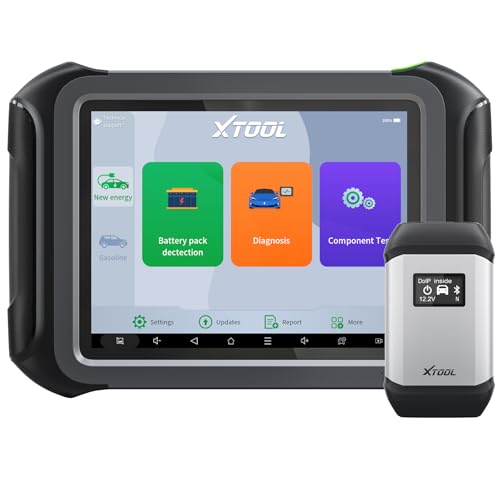
XTOOL D9EV Scan Tool High Voltage System/Battery Pack Analysis
Its EV-focused scan functions and high-voltage system analysis make it the strongest match for electric vehicle diagnostic work.

TOPDON BT600 12V 24V Car Battery Tester
Its wide voltage range, large screen, and built-in printer suit busy shops that also service conventional and low-voltage battery systems.

TOPDON BT200 Car Battery Tester
It offers useful 12V and 24V battery, cranking, and charging checks without the added cost and size of a printed report system.
TOPDON BT100 12V Battery Tester

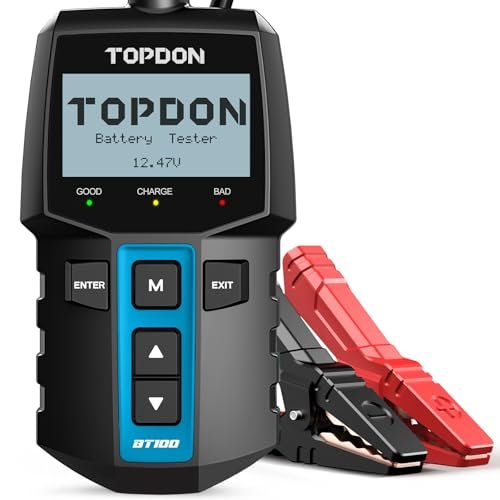
The TOPDON BT100 is a compact 12V automotive battery tester. It checks battery health, cranking performance, and charging system status. Its stated 100-2000 CCA range covers many common automotive battery sizes. This makes it a useful tool for home garages and small repair shops. The simple design also makes routine checks easier.
I would consider this tester for checking the low-voltage battery in a vehicle that uses a compatible 12V battery. That can include some electric vehicles, but battery type and tester support matter. The BT100 does not test the high-voltage traction pack or measure the full driving range of an EV battery. Its main value lies in basic electrical checks. It gives a practical way to spot a weak auxiliary battery before it causes other problems.
✅ Pros
- ✔ Tests common 12V automotive batteries.
- ✔ Supports a stated 100-2000 CCA testing range.
- ✔ Checks battery health and starting performance.
- ✔ Includes charging system test functions.
- ✔ Works with several vehicle types listed by the maker.
- ✔ Compact design makes storage and transport easy.
- ✔ Useful for routine low-voltage battery checks.
- ✔ Can help identify a weak auxiliary battery before replacement.
⚠️ Cons
- ✖ Does not test high-voltage EV traction batteries.
- ✖ Does not support 24V battery systems.
- ✖ Battery chemistry and compatibility must be checked before use.
- ✖ It lacks the advanced EV module scan features of a dedicated diagnostic tool.
My Recommendation
I recommend the TOPDON BT100 for owners and technicians who need a simple 12V battery tester. It is a practical choice for checking a compatible auxiliary battery in an EV or a standard vehicle. Its battery and charging checks can help narrow down common low-voltage faults. However, I would not buy it as the only tool for EV battery diagnosis. It cannot inspect the full high-voltage pack, read all EV battery control data, or test individual traction battery cells. Check the battery chemistry and supported test modes before connecting it to an EV.
| Best For | Why |
|---|---|
| Home Garage Owners | Its compact size and basic 12V test functions suit routine battery checks. |
| EV Auxiliary Battery Checks | It can test a compatible 12V battery without claiming to test the high-voltage pack. |
| Small Repair Shops | Its battery, cranking, and charging checks help with common electrical jobs. |
XTOOL D9EV EV Battery Scan Tool
The XTOOL D9EV is the most EV-focused product in this group. Its listed features include high-voltage system and battery pack analysis. It also offers vehicle scanning, topology mapping, ECU coding, PMI functions, and more than 4,000 bidirectional controls. The product listing also advertises support for Tesla and other electric vehicles. Its three-year update offer adds value for shops that need current software support.
I would place this tool first when shopping for the Best EV Battery Test Systems in this product list. It can help a technician access vehicle control modules and review supported battery system data. That is more useful for EV diagnosis than a basic 12V load tester. Still, a scan tool is not the same as a laboratory battery capacity tester. It does not replace approved high-voltage test equipment, cell-level measurement tools, or safe battery pack inspection methods. Before buying, check exact make, model, year, region, and software coverage.
✅ Pros
- ✔ Designed with electric vehicle diagnostics in mind.
- ✔ Lists high-voltage system and battery pack analysis.
- ✔ Advertises support for Tesla and other EV models.
- ✔ Offers topology mapping for supported vehicle systems.
- ✔ Includes more than 4,000 advertised bidirectional controls.
- ✔ Provides ECU coding and PMI functions where supported.
- ✔ Offers more than 46 listed reset functions.
- ✔ The advertised three-year update period can help keep software current.
- ✔ Offers more diagnostic depth than a basic 12V battery tester.
- ✔ Can help technicians investigate electronic faults across supported vehicle modules.
⚠️ Cons
- ✖ Vehicle coverage varies by make, model, year, and software version.
- ✖ It is not a direct cell-level battery capacity test bench.
- ✖ Advanced coding and service work require suitable training.
- ✖ Some functions may need extra steps or manufacturer-specific access.
- ✖ The professional feature set may be more than a casual EV owner needs.
My Recommendation
The XTOOL D9EV is my first choice for technicians who work on electric vehicles. Its EV-focused system access makes it the closest match to the main goal of this guide. I like that it combines battery system analysis with broader vehicle diagnostics and bidirectional controls. That can help a shop move from a warning light to a more useful fault check. I would still confirm the exact vehicle coverage before placing an order. A technician who needs measured pack capacity, cell balance data, or a controlled charge and discharge test may also need dedicated battery test equipment. Follow the maker’s safety steps and never open a high-voltage pack without the right training.
| Best For | Why |
|---|---|
| EV Repair Shops | Its EV system analysis and broad diagnostic functions suit professional fault finding. |
| Advanced Technicians | Bidirectional controls, coding, and topology mapping offer deeper access on supported vehicles. |
| Tesla And EV Diagnostics | Its advertised EV coverage makes it a strong option when the exact vehicle is supported. |
ANCEL BA101 12V Battery Tester

The ANCEL BA101 is a digital 12V battery and charging system tester. Its listed test range covers 100-2000 CCA. It can check battery condition, cranking performance, and alternator output. The product also lists support for cars, trucks, boats, RVs, and other vehicles. This broad use makes it a handy option for a garage that handles more than one vehicle type.
I see the BA101 as a basic electrical test tool rather than a full EV battery test system. It can help check a compatible 12V auxiliary battery in an electric vehicle. This matters because many EVs still use a separate low-voltage system to power vehicle electronics. A weak low-voltage battery can create faults that look more serious than they are. The BA101 cannot measure high-voltage traction battery capacity or inspect individual battery cells.
✅ Pros
- ✔ Tests common 12V automotive batteries.
- ✔ Offers a stated 100-2000 CCA range.
- ✔ Checks battery condition and starting performance.
- ✔ Includes charging system analysis.
- ✔ Can help identify common low-voltage electrical problems.
- ✔ Listed for use with cars, trucks, boats, and RVs.
- ✔ Useful for routine workshop battery checks.
- ✔ Provides a more structured check than a basic voltage reading.
⚠️ Cons
- ✖ Does not test EV high-voltage traction packs.
- ✖ Does not offer the EV module coverage of the XTOOL D9EV.
- ✖ Supports 12V systems rather than the listed 24V systems of some other testers.
- ✖ Users must confirm battery chemistry compatibility.
My Recommendation
I recommend the ANCEL BA101 for people who need an affordable and simple 12V battery diagnostic tool. It makes sense for a home garage, a small repair business, or an owner who also maintains boats and RVs. Its charging and cranking checks add value beyond a basic voltmeter. For EV use, I would limit its role to a compatible low-voltage battery. It is not suitable for direct testing of the main battery pack. If you need advanced EV fault codes or battery control module data, choose a dedicated EV scan tool instead.
| Best For | Why |
|---|---|
| DIY Vehicle Owners | It offers useful battery and charging checks for common 12V systems. |
| Small Auto Shops | Its CCA range and cranking tests help with routine battery service. |
| Boat And RV Owners | Its listed vehicle range makes it useful beyond passenger cars. |
TOPDON BT200 12V/24V Battery Tester
The TOPDON BT200 is a digital battery tester for 12V and 24V systems. It has a listed 100-2000 CCA testing range. It checks battery condition, cranking performance, and charging system operation. This makes it useful for technicians who service cars, trucks, SUVs, boats, and ATVs. Its wider voltage support gives it more range than a basic 12V-only tester.
For an EV owner, the BT200 may help with a compatible 12V auxiliary battery. It does not connect to or test the main high-voltage battery pack. I like its simple role in a wider diagnostic process. A technician can first check the low-voltage supply before spending time on more complex electronic faults. The 24V support is also useful for commercial vehicles, but it does not mean the tool can test a 24V EV traction system.
✅ Pros
- ✔ Supports listed 12V and 24V battery systems.
- ✔ Offers a 100-2000 CCA test range.
- ✔ Checks battery health and cranking performance.
- ✔ Includes charging system test functions.
- ✔ Works across several common vehicle types.
- ✔ Useful for mixed vehicle repair shops.
- ✔ Can help find weak auxiliary batteries.
- ✔ Offers more voltage flexibility than a 12V-only tester.
⚠️ Cons
- ✖ Does not measure EV traction battery capacity.
- ✖ Does not offer advanced EV module scanning.
- ✖ Battery chemistry support needs confirmation before use.
- ✖ It cannot replace a dedicated high-voltage battery test system.
My Recommendation
I would choose the TOPDON BT200 for a shop that works on both 12V and 24V vehicles. Its core functions cover many routine battery and charging checks. It is also a sensible support tool for EV service when a compatible 12V auxiliary battery needs testing. I would not treat it as a full EV diagnostic system. For that job, the XTOOL D9EV is the better match in this list. Check the exact battery type and test mode before use, especially when working with a modern EV that uses a lithium low-voltage battery.
| Best For | Why |
|---|---|
| Mixed Vehicle Workshops | Its 12V and 24V support suits shops with different vehicle types. |
| EV Auxiliary Battery Checks | It can test a compatible low-voltage battery as part of a wider diagnosis. |
| Truck Owners | Its 24V support adds value for compatible commercial vehicle systems. |
ANCEL BM200 Bluetooth Battery Monitor

The ANCEL BM200 is a Bluetooth battery monitor for 12V automotive systems. Its listed functions include battery testing, cranking checks, charging checks, alarms, and voltage history. It connects to a compatible phone so users can view battery information. This setup can make regular monitoring easier than opening the hood for every quick check. It is aimed at drivers who want to keep an eye on battery condition over time.
I like the idea of using a monitor to spot voltage changes before they lead to a problem. For a compatible EV auxiliary battery, this may help track the low-voltage system. However, a voltage history does not provide a full battery capacity test. It also does not read the EV battery management system or inspect the main traction pack. Owners should confirm the supported battery chemistry, installation method, and app requirements before buying.
✅ Pros
- ✔ Provides Bluetooth battery monitoring.
- ✔ Displays voltage information through a compatible phone.
- ✔ Records voltage history for later review.
- ✔ Includes listed cranking and charging test functions.
- ✔ Offers alarm features for selected battery conditions.
- ✔ Can help users notice unusual voltage changes.
- ✔ Useful for vehicles that sit unused for long periods.
- ✔ Provides a convenient way to check a compatible 12V system.
⚠️ Cons
- ✖ Limited to the listed 12V system.
- ✖ Does not test the high-voltage EV battery pack.
- ✖ Bluetooth and app support are needed for its smart features.
- ✖ Voltage monitoring alone cannot confirm actual battery capacity.
- ✖ Battery chemistry compatibility must be checked.
My Recommendation
I recommend the ANCEL BM200 for drivers who prefer ongoing battery monitoring. It is a good fit for a car, RV, boat, or compatible EV auxiliary battery that needs regular checks. The voltage history and alarm features can make it easier to spot a change. I would pair it with a proper battery tester when a full condition check is needed. For EV traction battery health, use a compatible professional scan tool and approved test equipment. The BM200 is best viewed as a monitoring aid, not a complete EV battery test system.
| Best For | Why |
|---|---|
| Connected Car Owners | Bluetooth access makes basic battery monitoring more convenient. |
| RV And Boat Owners | Voltage history can help track a compatible battery during storage. |
| EV Auxiliary Battery Monitoring | It can help watch a compatible 12V system between service visits. |
12V Plug-In Battery And Charging Tester
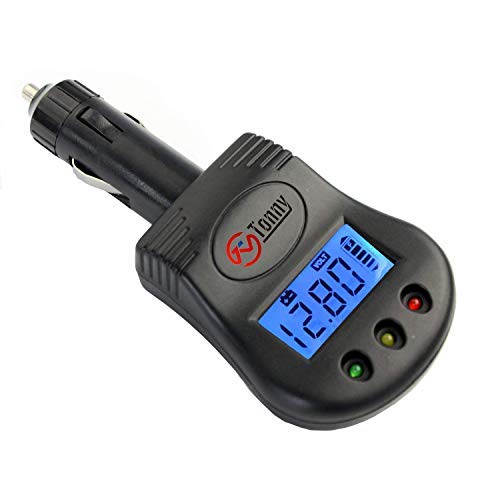
This 12V plug-in tester is a simple tool for checking vehicle battery voltage and charging condition. It uses an LCD display to show electrical readings. The plug-in design can make a quick check easy when the vehicle has a compatible power outlet. It is a basic option for drivers who want a fast look at their vehicle’s low-voltage supply. It does not offer the broad test functions of a professional battery analyzer.
I see this tool as a quick voltage monitor rather than a true load tester. A voltage reading can give useful clues, but it cannot prove that a battery can deliver enough power under demand. This matters when diagnosing an EV auxiliary battery or a traditional starter battery. Many electric vehicles also manage their low-voltage systems in ways that differ from conventional cars. Check the vehicle manual before using a plug-in device, and do not assume the outlet stays powered in every operating state.
✅ Pros
- ✔ Offers a simple LCD voltage display.
- ✔ Makes quick low-voltage checks easy.
- ✔ Uses a convenient plug-in design.
- ✔ Can help spot very low voltage readings.
- ✔ Requires less setup than a full battery analyzer.
- ✔ Useful for basic vehicle electrical checks.
- ✔ Compact design is easy to keep in a glove box.
- ✔ Can provide a quick first check before deeper diagnosis.
⚠️ Cons
- ✖ Does not perform a full battery load test.
- ✖ Does not test EV high-voltage battery packs.
- ✖ Only works with a suitable powered outlet.
- ✖ Cannot confirm battery capacity from voltage alone.
- ✖ Offers fewer diagnostic functions than a professional tester.
My Recommendation
I would choose this plug-in tester for simple voltage checks, not for professional battery diagnosis. It can help a driver notice a low reading without using a larger tool. That may be useful as part of basic low-voltage monitoring. However, I would not rely on it to decide whether an EV battery needs replacement. It cannot measure pack health, cell balance, or usable energy. For a proper battery condition check, choose a compatible analyzer or an EV scan tool with suitable vehicle coverage.
| Best For | Why |
|---|---|
| Casual Drivers | It gives a quick view of voltage without a complex setup. |
| Basic Voltage Checks | The LCD makes simple readings easy to view. |
| Budget Tool Kits | It provides a basic check without the features of a costly diagnostic system. |
TOPDON BT600 Battery Tester With Printer
The TOPDON BT600 is a more advanced battery tester for 12V and 24V systems. It has a 3.5-inch screen and a built-in printer. Its listed 100-2000 CCA range supports many common automotive battery sizes. It also checks battery condition, cranking performance, and charging system operation. These features make it a useful option for a busy repair shop that needs clear test results.
The built-in printer is one of its strongest features. A shop can use printed results to explain a battery condition to a customer or keep a service record. I would also consider it for checking a compatible EV low-voltage battery. However, the BT600 does not measure the high-voltage traction pack. Its 12V and 24V ratings refer to the supported low-voltage battery systems, not the large drive battery in an electric car. Always check the selected battery type and vehicle requirements before testing.
✅ Pros
- ✔ Supports listed 12V and 24V battery systems.
- ✔ Offers a 100-2000 CCA test range.
- ✔ Includes a large 3.5-inch display.
- ✔ Has a built-in printer for physical test reports.
- ✔ Checks battery condition and cranking performance.
- ✔ Includes charging system test functions.
- ✔ Useful for shops that need customer test records.
- ✔ Can support routine checks on compatible auxiliary batteries.
- ✔ Offers more reporting convenience than a basic handheld tester.
⚠️ Cons
- ✖ Does not directly test high-voltage EV traction packs.
- ✖ The printer adds size and extra supply needs.
- ✖ Advanced EV battery module data is outside its core role.
- ✖ Battery chemistry support should be confirmed before purchase.
- ✖ May be more tool than a casual owner needs.
My Recommendation
The TOPDON BT600 is my preferred choice for professional low-voltage battery testing in a busy shop. Its printer can make customer reports and service records easier to manage. Its 12V and 24V support also helps when a shop handles different vehicle classes. For an EV workshop, I would use it as a supporting tool for compatible low-voltage batteries. I would pair it with the XTOOL D9EV or another suitable EV diagnostic system for vehicle-level battery analysis. It is not a replacement for a high-voltage battery test bench.
| Best For | Why |
|---|---|
| Professional Repair Shops | Its test reports can help explain battery results to customers. |
| Fleet Service Teams | The 12V and 24V range suits many service vehicle types. |
| EV Service Departments | It can support compatible low-voltage battery checks alongside EV diagnostics. |
TOPDON BT300P Battery Tester With Printer

The TOPDON BT300P is a 12V and 24V battery tester with a built-in printer. Its listed CCA range is 100-2000. It checks battery condition, cranking performance, and charging system status. The product also lists reverse polarity protection. This feature can help reduce the risk of damage from an incorrect clamp connection, although users should still follow the correct setup steps.
I would consider the BT300P for a professional garage that wants test results it can share with customers. The printer can make battery service easier to document. Its voltage support also gives it a role in shops that work on cars and larger vehicles. For EV work, its use remains limited to compatible low-voltage battery systems. It does not test the high-voltage traction pack, measure total pack capacity, or inspect cell balance. That distinction is important when choosing the Best EV Battery Test Systems.
✅ Pros
- ✔ Supports listed 12V and 24V batteries.
- ✔ Offers a 100-2000 CCA test range.
- ✔ Includes a built-in printer.
- ✔ Checks battery condition and cranking performance.
- ✔ Includes charging system analysis.
- ✔ Lists reverse polarity protection.
- ✔ Useful for keeping printed battery test records.
- ✔ Suitable for several common vehicle service tasks.
- ✔ Can help check a compatible low-voltage EV battery.
⚠️ Cons
- ✖ Does not provide direct EV traction battery testing.
- ✖ Printed reports add a need for paper supplies.
- ✖ Does not replace a vehicle-specific EV scan tool.
- ✖ Users must confirm support for the battery chemistry in their vehicle.
My Recommendation
I recommend the TOPDON BT300P for repair shops that value printed battery test reports. Its 12V and 24V support gives it a wide role in conventional vehicle service. The listed reverse polarity protection is also a useful safety feature, but it does not remove the need to connect the clamps correctly. For EV technicians, I see it as a supporting tool for suitable low-voltage batteries. I would not use it as the main system for high-voltage battery diagnosis. A dedicated EV scan tool and approved high-voltage test equipment are still needed for that work.
| Best For | Why |
|---|---|
| Independent Repair Shops | Printed reports help document battery condition and service results. |
| 12V And 24V Battery Service | Its listed voltage range supports several common vehicle types. |
| EV Auxiliary Battery Checks | It can support testing when the EV uses a compatible low-voltage battery. |
FOXWELL BT705 12V/24V Battery Tester
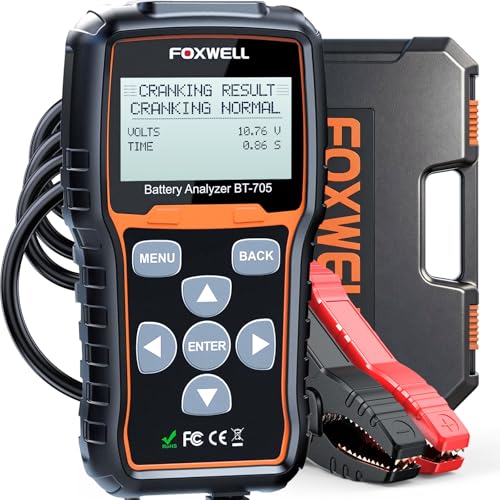
The FOXWELL BT705 is a digital battery and charging system tester for 12V and 24V applications. Its listed 100-2000 CCA range covers many common automotive battery sizes. It checks battery condition, cranking performance, and charging system operation. The product listing also mentions a 5.9-foot cable. That longer cable can give a technician more room to work around a vehicle during a test.
I would consider the BT705 for a workshop that handles cars, trucks, RVs, and boats. Its wider voltage support makes it useful for mixed service work. It can also play a supporting role when checking a compatible 12V auxiliary battery in an EV. Still, it cannot test the large high-voltage drive battery. I would use it to check a low-voltage supply issue, then move to a vehicle-specific scan tool if the fault remains. Battery type and test mode must match the vehicle.
✅ Pros
- ✔ Supports listed 12V and 24V battery systems.
- ✔ Offers a 100-2000 CCA testing range.
- ✔ Checks battery condition and cranking performance.
- ✔ Includes charging system analysis.
- ✔ Has a listed 5.9-foot cable.
- ✔ Works for several common vehicle categories.
- ✔ Useful for workshops that service cars and trucks.
- ✔ Can support compatible EV auxiliary battery checks.
- ✔ Offers a practical option for routine battery diagnosis.
⚠️ Cons
- ✖ Does not test high-voltage EV traction batteries.
- ✖ Does not provide the advanced EV scanning features of the XTOOL D9EV.
- ✖ Battery chemistry support must be confirmed.
- ✖ Its feature set may be more than a casual car owner needs.
My Recommendation
The FOXWELL BT705 is a good option for technicians who need a 12V and 24V battery tester with a longer cable. I like its focus on basic battery, cranking, and charging checks. It may suit a shop that handles a broad mix of vehicles every day. EV owners can consider it only when they need to test a compatible low-voltage battery. It is not a high-voltage pack analyzer. If your main work involves EV battery warnings, module data, or control system faults, add a proper EV diagnostic scanner to your tool kit.
| Best For | Why |
|---|---|
| Professional Technicians | It covers common battery and charging tests in one tool. |
| Truck And RV Service | Its listed 12V and 24V support gives it broad workshop use. |
| Longer Reach Testing | The listed 5.9-foot cable can offer more working room. |
KONNWEI KW208 12V Battery Tester

The KONNWEI KW208 is a compact digital tester for 12V automotive batteries. It checks battery condition, starter performance, and charging system operation. Its listed use covers cars, trucks, motorcycles, boats, and other compatible vehicles. This gives it a useful role in a home garage or a small repair shop. Its main appeal is a simple approach to common 12V battery checks.
I would look at the KW208 when I need a basic battery analyzer without the extra features of a large professional scan tool. It can help check a compatible low-voltage battery in an EV. It cannot access the main battery management system or test the high-voltage traction pack. A 12V test result also cannot tell you how much driving range remains. For that, you need vehicle-specific battery data and suitable diagnostic equipment.
✅ Pros
- ✔ Tests common 12V automotive batteries.
- ✔ Checks battery condition and starter performance.
- ✔ Includes charging system testing.
- ✔ Supports several listed vehicle types.
- ✔ Useful for basic home garage checks.
- ✔ Compact design makes storage simple.
- ✔ Can help find weak low-voltage batteries.
- ✔ Offers more information than a basic voltage-only meter.
⚠️ Cons
- ✖ Does not support the listed 24V test range.
- ✖ Cannot test high-voltage EV battery packs.
- ✖ Does not offer advanced EV module diagnostics.
- ✖ Battery type compatibility should be checked before use.
My Recommendation
I recommend the KONNWEI KW208 for home users who need a straightforward 12V battery tester. Its battery, starter, and charging checks cover many common jobs. It can be useful for an EV owner who needs to inspect a compatible auxiliary battery. However, I would not choose it for a professional EV battery service department. It lacks the high-voltage system analysis and vehicle module access found in a dedicated EV scan tool. Think of it as a supporting electrical tool rather than a complete EV battery test system.
| Best For | Why |
|---|---|
| Home Mechanics | Its simple 12V testing functions suit common garage tasks. |
| Motorcycle Owners | It can support compatible 12V battery checks. |
| Basic EV Auxiliary Checks | It offers a way to check a compatible low-voltage battery. |
Final Verdict: Which Should You Buy?
The XTOOL D9EV is my overall winner among these Best EV Battery Test Systems because it offers the strongest EV-focused diagnostic features. It can help technicians review supported high-voltage system data and access vehicle modules. For low-voltage battery testing, the TOPDON BT600 is a strong professional choice, while the BT200 offers a simpler 12V and 24V option. Remember that none of the standard 12V testers in this list can test an EV traction pack.
Choose a tool that matches your vehicle and test needs. Check software coverage, battery chemistry, and safety rules before buying. The right EV battery diagnostic tools can save time and help find faults with greater care.
FAQs Of Best EV Battery Test Systems
Q What Is The Best EV Battery Test System In This List?
Q Can A 12V Battery Tester Check An EV Battery?
Q How Can I Check The Health Of An EV Traction Battery?
Q What Is The Difference Between Battery Voltage And Battery Health?
Q Do I Need A Professional EV Battery Tester For Home Use?