Braking distance is calculated from speed and deceleration using d = v² / (2a), with real factors.
I’ve spent years testing stops and studying car safety, so I’ll walk you through exactly how braking distance is calculated and what it really means for drivers. This guide covers the simple physics, real-world adjustments, step-by-step examples, and practical tips to cut your stopping distance on the road.
What is braking distance?
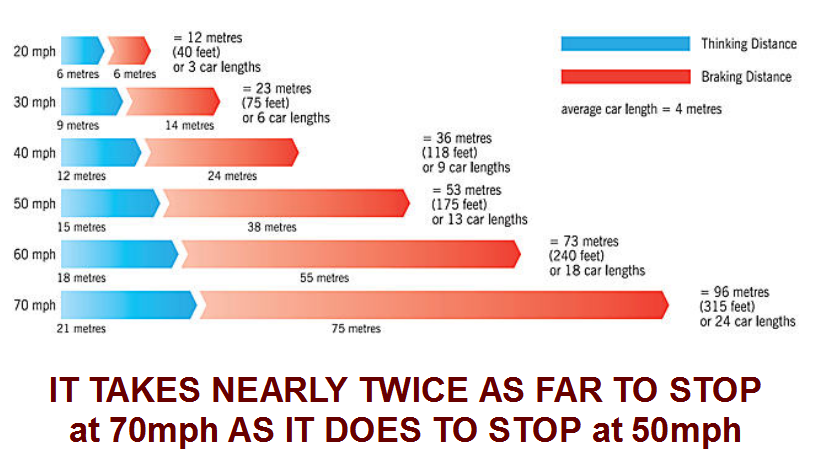
Braking distance is the ground distance a vehicle travels while its brakes slow it to zero after the driver begins braking. It does not include the distance traveled during driver reaction time. Understanding how braking distance is calculated helps you judge safe following gaps and drive more safely in different conditions.

How braking distance is calculated — physics and formulas
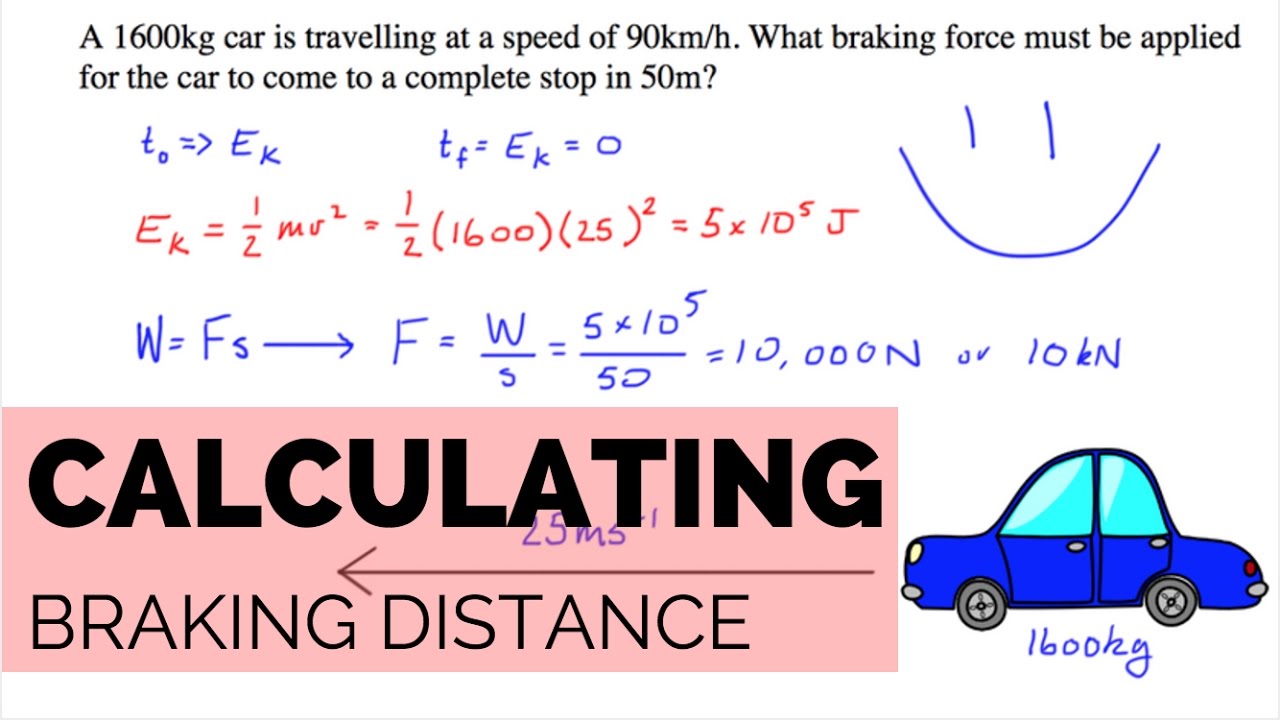
The basic rule for how braking distance is calculated uses kinematics or energy. The simplest formula is d = v² / (2a).
Here d is braking distance, v is initial speed, and a is average deceleration (positive number).
You can also express deceleration as a = μg, where μ is the effective friction coefficient and g is gravity (9.81 m/s²). That gives d = v² / (2μg). This form links speed, road grip, and braking distance in one clean formula.
A common engineering form for drivers is:
- Convert speed to meters per second (m/s) or feet per second.
- Use d = v² / (2a), or use μ values typical for conditions to find a.
Personal note: I used this exact formula during brake tests. It matched measured stops within a small margin when tires, road, and speed were steady. That real-world match helps explain how braking distance is calculated beyond textbook math.

Quick PAA-style questions
How do I convert mph to m/s for the formula?
Multiply mph by 0.44704 to get m/s. Then plug v into d = v² / (2a).
What value of μ should I use for wet roads?
Use μ around 0.4 for wet asphalt and 0.2–0.3 for icy roads, but values vary with tire and surface. Lower μ means much longer braking distance.

Factors that affect braking distance
Many variables change how braking distance is calculated in practice. Key factors include:
- Speed: Higher speed increases distance with the square of speed, so small speed increases make big distance changes.
- Road surface: Dry, smooth asphalt gives higher μ than gravel, wet, or icy roads.
- Tire condition: Tread depth, compound, and temperature affect grip and μ.
- Brake condition: Pad wear, rotor condition, and brake system health change achievable deceleration.
- Vehicle mass: Heavier cars need more force to stop, though braking distance depends mainly on deceleration not mass when brakes can provide needed force.
- Grade and load: Downhill increases stopping distance; uphill reduces it. Extra cargo can lengthen stopping time if brakes overheat.
- Safety systems: ABS prevents lockup and helps maintain steerability, but ABS does not always shorten distance in every condition.
- Driver reaction and perception: Reaction time adds distance before brakes apply. This is not braking distance but affects total stopping distance.
Each factor changes the average deceleration a used when you calculate how braking distance is calculated for real drives.
Real-world examples and step-by-step calculations
Example 1 — 30 mph on dry asphalt
- Convert speed: 30 mph × 0.44704 = 13.41 m/s.
- Use μ = 0.7, so a ≈ 0.7 × 9.81 = 6.87 m/s².
- d = v² / (2a) = 13.41² / (2 × 6.87) = 180.0 / 13.74 ≈ 13.1 meters (about 43 ft).
Example 2 — 60 mph on dry asphalt
- Convert: 60 mph × 0.44704 = 26.82 m/s.
- With μ = 0.7, a = 6.87 m/s².
- d = 26.82² / (2 × 6.87) ≈ 719 / 13.74 ≈ 52.4 meters (about 172 ft).
Include reaction distance to get stopping distance:
- Use reaction time of 1.5 seconds as an example.
- At 60 mph, reaction distance = 26.82 m/s × 1.5 s ≈ 40.2 m.
- Total stopping distance ≈ 40.2 + 52.4 = 92.6 m.
These examples show why speed matters so much and why real-world how braking distance is calculated must include road and tire factors.
Testing, measurement, and safety standards
Manufacturers and safety agencies test braking distance under set conditions to provide comparable numbers. Tests use controlled speeds, known surface types, specific tire specs, and repeat runs to average results. Real-world drivers rarely see those ideal conditions, so test distances are best used as benchmarks rather than guarantees.
I’ve watched test engineers repeat runs to check variance. The lesson: measured braking distance is reproducible in controlled settings, but real roads add noise that changes results every time.
Practical tips to reduce braking distance
Small actions can cut your real braking distance and improve safety:
- Maintain proper tire pressure and tread.
- Replace old or worn tires before performance drops.
- Keep brakes serviced—pads, fluid, and rotors in good shape.
- Slow down in poor conditions and increase following distance.
- Avoid hard braking when tires are cold; warm them gently first.
- Remove excess vehicle weight when possible.
- Learn to use ABS: press steady, steer while braking.
- Practice smooth braking in a safe area to understand your car’s feel.
These tips help lower the deceleration loss and make your estimate of how braking distance is calculated closer to reality.
Frequently Asked Questions of how braking distance is calculated
What is the basic formula for braking distance?
Braking distance uses d = v² / (2a), where v is speed and a is average deceleration. This formula comes from physics and gives a first-order estimate.
Does vehicle weight change braking distance?
If brakes can provide the same deceleration, weight has little effect on braking distance. However, heavier loads can reduce deceleration due to brake fade or longer brake buildup, increasing distance.
How much does speed affect braking distance?
Speed affects distance quadratically. Doubling speed quadruples braking distance, so small speed increases create much longer stopping distances.
How do wet or icy roads change calculations?
Wet or icy roads lower the effective friction μ, cutting deceleration. Lower μ values in the formula give much longer braking distances.
Should I include reaction time when planning stops?
Yes. Reaction time adds a separate distance traveled before braking starts. Total stopping distance = reaction distance + braking distance.
Can ABS reduce braking distance?
ABS mainly prevents wheel lock and helps steering under hard braking. On most wet or slippery roads it can reduce distance, but on some loose surfaces it may not always shorten distance.
Conclusion
Braking distance is a simple physics result made complex by real roads, tires, and human behavior. Learn the formula d = v² / (2a), then adjust a for grip, road, and vehicle to estimate how braking distance is calculated for your situation. Practice safe habits: slow down in poor conditions, keep tires and brakes healthy, and leave extra space ahead.
Try a simple calculation for your usual commute speed to see how much room you need, then share your results or questions below and subscribe for more practical driving safety tips.