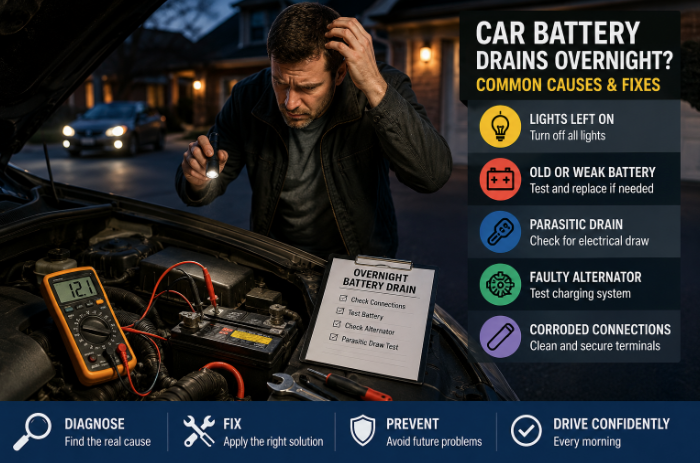
If your car battery dies overnight, the most likely causes are a parasitic electrical drain, a weak battery, an alternator problem, or an electrical accessory that stays on after you park. Test the battery, charging system, and key-off electrical draw before buying a replacement.
In the United States, a car may sit overnight in a suburban driveway, an apartment parking lot, or a work garage. You park it after a normal drive, turn off the engine, and expect it to start the next morning. Instead, you turn the key or press the start button and get a click, dim lights, or no response at all. This can happen in any season, although cold winter mornings can make a weak battery problem much easier to notice.
A battery that loses its charge overnight does not always need replacement. Something may be using electricity while the engine is off. A faulty alternator may also fail to charge the battery properly, while an old battery may no longer hold enough energy to start the engine. These problems can produce similar symptoms, so guessing can lead to unnecessary repairs.
The best way to find the cause is to check the battery’s condition first, inspect the charging system, and then measure the electrical draw after the vehicle’s computers have entered sleep mode. This guide explains the common causes, practical checks, safe testing methods, and signs that you need help from an automotive technician.
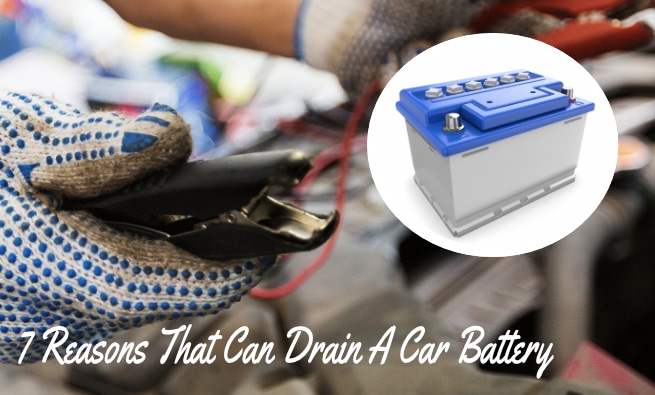
Source: letmagazine.co.uk
What Does It Mean When a Car Battery Dies Overnight?
A car battery stores electrical energy for starting the engine and powering electrical equipment when the engine is off. When you start the car, the battery sends a large amount of current to the starter motor. Once the engine runs, the charging system normally restores the energy used during starting.
Some electrical systems continue to use a small amount of power after you park. This is normal. The clock, security system, radio memory, and some control modules may need a small supply of electricity. The problem starts when the vehicle uses more power than its battery can safely provide while parked.
A battery that becomes completely dead overnight has either lost much of its ability to store energy or experienced an unusually high electrical load. Sometimes both problems exist together. For example, a small electrical drain that a healthy battery could tolerate may leave an old battery unable to start the engine.
Normal battery standby use
Small electrical loads keep selected vehicle systems ready while the engine is off. Their current use should remain within the vehicle manufacturer’s limits.
Parasitic battery drain
An electrical component continues drawing too much current after the vehicle has shut down. This can gradually remove the battery’s stored energy.
Battery capacity loss
An aging or damaged battery cannot store or deliver enough energy. Even a normal standby load may become too much for it.
Charging system trouble
A weak alternator or poor electrical connection may leave the battery partly charged before the vehicle is parked.
Signs That Your Battery Is Losing Power While Parked
The first sign is often a slow engine crank in the morning. The starter may turn the engine more slowly than usual, or you may hear rapid clicking when you press the start button. In more severe cases, the dashboard stays dark and the vehicle does not respond.
Pay attention to what happens after you jump-start the car. If it starts normally but becomes dead again after sitting overnight, the battery or charging system needs further testing. Repeated jump-starts are not a repair.
Dim dashboard lights
The instrument panel or interior lights appear weak when you unlock or start the vehicle.
Slow engine cranking
The starter turns the engine slowly, especially after the vehicle has been parked for several hours.
Repeated clicking
The starter solenoid may click without enough battery power to turn the engine.
Repeated jump-starts
The car starts after a boost but loses enough power to fail again after being parked.
Common Reasons a Car Battery Drains Overnight
Several electrical and mechanical problems can cause a battery to lose power overnight. The most useful clue is often when the problem began. If it started after installing a dash camera, alarm, stereo, or tracking device, inspect that equipment first. If the battery problem appeared without any recent changes, check the battery, charging system, and vehicle wiring.
Source: carmedis.com
Interior lights that stay on
A glove box, trunk, vanity mirror, or dome light may remain on because of a damaged switch or faulty door sensor. You may not notice the light from outside the vehicle.
Headlights or parking lights left on
A lighting control fault or incorrect switch setting can leave exterior lights operating after the engine is off. Automatic lighting systems can also develop faults.
Aftermarket electrical accessories
Dash cameras, GPS trackers, remote starters, alarms, amplifiers, and other accessories may draw power continuously if they are wired incorrectly.
Faulty electrical relay
A relay with stuck internal contacts can keep a fan, pump, lighting circuit, or another electrical component powered after shutdown.
Control module that stays awake
A vehicle computer may fail to enter its normal sleep state because of a software problem, faulty switch, communication issue, or defective module.
Alternator diode failure
A damaged rectifier diode can allow current to flow backward through the alternator when the engine is off. This may create an electrical drain even when the alternator appears to charge the battery while driving.
Damaged wiring or electrical short
Worn insulation, damaged wires, poor repairs, or moisture inside electrical connectors can create unwanted current paths.
Weak or aging battery
An old battery may have lost much of its original capacity. It can become too weak to start the engine after a normal night of standby use.
Parasitic Drain From a Dash Camera or GPS Tracker
A dash camera with parking mode can continue recording after you turn off the engine. A GPS tracker may also remain active to report the vehicle’s location. These features can be useful, but their electrical demand needs proper control.
The problem often appears after a new accessory is installed. Some devices connect directly to a constant battery supply so they can work while parked. If the device has no suitable low-voltage cutoff or shutdown setting, it may use more energy than expected.
Check the accessory’s wiring and power settings. A qualified installer can determine whether the device should use an ignition-controlled connection or a properly configured battery protection system.
Check parking mode
See whether the dash camera continues recording after the vehicle is locked.
Inspect the power connection
Check whether the accessory uses a constant battery supply or an ignition-controlled circuit.
Check the low-voltage cutoff
Confirm that the accessory has a suitable battery protection setting and that it works correctly.
A Vehicle Computer That Never Enters Sleep Mode
Modern cars contain many electronic control units. These systems manage functions such as security, engine control, infotainment, lighting, and keyless entry. They may remain active for a period after you switch off the engine.
After the vehicle completes its shutdown process, most systems should enter a low-power state. A faulty door latch, trunk switch, communication module, or control unit may prevent this from happening.
A nearby key fob can also affect some keyless entry systems. The vehicle may continue monitoring for the key if it remains within the system’s detection range. Follow the owner’s manual when storing the key away from the parked vehicle.
Faulty door or trunk switch
The vehicle may believe a door or trunk is still open and keep selected systems active.
Keyless entry activity
A nearby key fob may cause repeated communication between the vehicle and its access system.
Software or module problem
A control unit may fail to shut down correctly or may repeatedly wake up.
Can a Bad Alternator Drain the Battery Overnight?
Yes, certain alternator faults can contribute to an overnight battery drain. The alternator normally supplies electricity while the engine runs and helps recharge the battery. Its rectifier diodes help prevent current from flowing backward when the engine is off.
If a diode becomes damaged, current may leak through the alternator after you park. A faulty alternator may also produce insufficient charging power, leaving the battery undercharged before the next start.
A charging system test can identify poor alternator output, while a parasitic draw test can help confirm whether the alternator is using current with the engine off. Do not disconnect the alternator’s main power cable yourself as a test. That connection can remain live and create a serious short-circuit hazard.
Battery warning light
A charging system warning light while driving may indicate an alternator or charging circuit problem.
Repeated battery failure
The battery may become weak again soon after charging or jump-starting.
Unusual electrical behavior
Flickering lights or electrical problems may appear along with poor charging performance.
How Battery Age, Weather, and Driving Habits Affect Overnight Starting
Not every overnight battery failure comes from an electrical component that stays on. The battery itself may be weak, or the charging system may not restore enough energy during normal driving. Weather and driving habits can make these problems more noticeable.
A battery that starts the car after a long drive may still fail after sitting overnight. This happens because driving can temporarily improve its charge, while an internal battery problem prevents it from holding enough energy for the next start.
Source: livguard.com
Battery age
Battery capacity gradually declines with use, heat exposure, charging cycles, and age. A battery near the end of its service life may struggle to hold a charge.
Extreme cold
Cold weather reduces the battery’s ability to deliver starting power. Engine oil also becomes harder to move, increasing the effort needed to start the engine.
High temperatures
Heat can speed up battery aging and damage internal components. A battery weakened during hot weather may become more noticeable during later cold starts.
Frequent short trips
Repeated short drives may not give the alternator enough time to replace the energy used during starting.
Long periods without driving
A parked vehicle continues to use some power for security and electronic memory. A weak or partly discharged battery may eventually lose its starting ability.
Poor battery connections
Loose or corroded terminals can restrict current flow and create starting problems that resemble a weak battery.
Why Cold Weather Makes the Problem Worse
A cold morning can expose a battery problem that was already present. Low temperatures reduce the amount of starting power a battery can provide, while the engine may need more power to turn over.
This does not mean cold weather is always the original cause of the drain. An electrical accessory, weak battery, or charging problem may have reduced the available charge before the temperature dropped.
If the battery is frozen, cracked, swollen, or leaking, do not attempt a jump-start. Have it inspected by a qualified technician.
Check the battery condition
Have the battery tested if starting becomes slower during cold mornings.
Use a suitable charger
Follow the battery manufacturer’s charging instructions and use equipment designed for the battery type.
Inspect the terminals
Loose or corroded connections can make cold-weather starting even harder.
Why Short Trips Can Leave the Battery Undercharged
Starting an engine uses a large amount of electrical energy for a short period. The alternator replaces that energy while the vehicle runs, but repeated short trips may not provide enough charging time.
Frequent use of the heater blower, headlights, rear defroster, heated seats, and other electrical equipment can add to the demand. If the battery is already weak, it may struggle to recover between trips.
A proper battery charger can restore the battery more fully than relying on a short drive. If the problem continues, have the battery and charging system tested.
How to Diagnose a Car Battery That Drains Overnight
The most reliable approach is to test the battery, check the charging system, and then measure the electrical draw with the vehicle switched off. This order helps separate a weak battery from an electrical problem and reduces the risk of replacing a part that still works.
You can perform a few basic visual checks at home. However, measuring parasitic current on a modern vehicle requires care because opening a door, removing a fuse, or disconnecting the battery can wake up control modules and change the result.
Source: youramazingcar.com
Step 1: Check the Battery and Electrical Accessories
Start with a visual inspection. Park the vehicle safely, switch off the ignition, and look for obvious signs of damage, corrosion, or loose connections. Do not touch a battery that appears swollen, cracked, leaking, or unusually hot.
Check the glove box, trunk, cabin lights, headlights, and other electrical equipment. Look for a dash camera, phone charger, tracking device, or aftermarket accessory that may remain active when the vehicle is parked.
If you find an accessory that stays on, check its normal operating instructions before changing its wiring. Do not remove random electrical connections.
Inspect the battery terminals
Look for loose clamps, corrosion, damaged cables, or signs of overheating.
Check all lights
Make sure the interior, trunk, glove box, and exterior lights switch off correctly.
Review recent installations
Pay special attention to accessories installed shortly before the battery problem began.
Step 2: Fully Charge and Test the Battery
A battery should be charged before its health is judged. A low voltage reading may simply mean the battery is discharged. It does not automatically prove that the battery has failed.
Use a charger approved for the battery’s chemistry and follow the manufacturer’s instructions. Then have the battery checked with a suitable conductance or load tester. These tests help determine whether it can deliver the power needed to start the engine.
A basic multimeter can measure resting battery voltage, but voltage alone cannot confirm battery health. A battery may show a reasonable resting voltage and still fail under a starting load.
Check battery type
Identify whether the vehicle uses a standard flooded battery, AGM battery, EFB battery, or another approved design.
Charge before testing
Use a suitable charger and follow the battery maker’s charging procedure.
Request a battery health test
Ask for a test that checks the battery’s ability to deliver starting current, not just its resting voltage.
Step 3: Test the Alternator and Charging System
If the battery passes its health test, check whether the charging system works correctly. A technician can measure alternator output, inspect the drive belt where applicable, and check the battery cables and ground connections.
Modern vehicles may use smart charging systems that change alternator output based on battery condition, temperature, and electrical demand. Therefore, a single voltage reading should not be used as a universal pass-or-fail test.
If the alternator cannot supply the required charging power, the battery may remain partly discharged after driving. A damaged rectifier diode may also contribute to an electrical drain while the engine is off.
Check the charging warning light
A warning light while driving can indicate a charging system problem.
Inspect the drive belt
A loose, damaged, or slipping belt may affect alternator operation on vehicles that use a belt-driven alternator.
Check alternator ripple
A technician can use suitable test equipment to identify abnormal electrical output that may indicate a diode problem.
Step 4: Perform a Parasitic Battery Draw Test
A parasitic draw test measures how much current the vehicle uses after the ignition is off and its electronic systems have entered sleep mode. This is one of the most useful tests when the battery is healthy but repeatedly becomes discharged while parked.
The technician may use a suitable low-current DC clamp meter or a digital multimeter connected in series with the battery circuit. The vehicle must be prepared correctly. Doors, trunk switches, security systems, and keyless entry functions can affect the result.
Do not judge the reading immediately after turning off the engine. Some vehicles need 30 minutes to two hours for all relevant modules to shut down. The exact waiting period depends on the vehicle and its equipment.
A reading taken too early may show normal shutdown activity rather than a fault. Some systems also wake periodically to check vehicle conditions, so an intermittent current pattern may need longer monitoring.
Turn off all accessories
Switch off the ignition, lights, chargers, and other electrical equipment before testing.
Prepare the vehicle for sleep mode
Close and lock the vehicle as required by the manufacturer’s test procedure. Keep keyless entry keys outside the detection range.
Allow enough time
Wait for the vehicle’s control modules to enter their specified sleep state before judging the current reading.
Compare the result with factory specifications
Use the correct current limit for the exact vehicle rather than relying on one universal figure.
Step 5: Find the Circuit Causing the Drain
If the measured current remains above the manufacturer’s limit, the next step is to find which circuit uses the excess power. A technician can use the vehicle’s fuse diagram and wiring information to narrow down the source.
One method is to monitor voltage drop across fuse test points. Current flowing through a fuse creates a small voltage drop that can help identify an active circuit without removing the fuse. The correct fuse data is needed because readings vary with fuse type and rating.
Another method is to remove or isolate selected fuses while monitoring current. However, pulling a fuse can wake electronic modules or reset a system. The technician may need to wait for the vehicle to enter sleep mode again before taking another reading.
Once the affected circuit is known, inspect its wiring, switches, relays, control modules, and connected accessories. The goal is to identify the actual failed component rather than replacing everything on that circuit.
Check the fuse diagram
Identify which systems are protected by the circuit showing excessive current.
Inspect the connected components
Check for stuck relays, damaged switches, faulty modules, and incorrectly wired accessories.
Repeat the measurement
Confirm that the repair brings the sleeping current within the vehicle manufacturer’s specification.
Step 6: Confirm That the Repair Works
A successful repair should solve the electrical problem, not just make the battery start once. After the repair, the technician should repeat the battery and charging tests where needed and verify the key-off current.
The vehicle should complete its normal shutdown process without an excessive electrical load. If the original problem was intermittent, longer monitoring or an overnight test may be necessary.
A final battery test is also useful if the battery has been deeply discharged several times. Repeated deep discharges can reduce its remaining capacity even after the original drain has been repaired.
How Much Battery Drain Is Normal Overnight?
A parked vehicle normally uses a small amount of electricity. The acceptable amount depends on its design, security equipment, telematics, and control modules. Some technical guidance uses less than 50 milliamps as a general reference, but this is not a universal limit for every vehicle.
For example, Fluke discusses less than 50 mA as a typical guide after sleep mode. Other technical guidance describes a broader range and emphasizes that the vehicle manufacturer’s specification takes priority. Some vehicles also have periodic wake-up cycles that create short increases in current.
The best way to interpret a reading is to compare it with the exact manufacturer’s specification after the vehicle has fully entered sleep mode. A high reading is a reason to investigate, not automatic proof that a particular component has failed.
Use the correct measurement conditions
The vehicle must be switched off and fully asleep. A reading taken during the normal shutdown period can be misleading.
Check the vehicle-specific limit
A specification for one make or model should not be applied automatically to another.
Watch for intermittent activity
Some control modules wake periodically, so a single brief reading may not reveal the full pattern.
Simple Examples of Overnight Battery Use
You can estimate how much energy a steady electrical load uses with a simple calculation. Multiply the current in amps by the number of hours. This gives the approximate number of amp-hours used during that period.
The following examples assume a steady current for 12 hours. They are mathematical illustrations, not measurements from a specific vehicle. Actual battery performance also depends on battery health, temperature, starting demand, and the vehicle’s electrical design.
50 milliamps for 12 hours
0.05 amps multiplied by 12 hours equals approximately 0.6 amp-hours.
250 milliamps for 12 hours
0.25 amps multiplied by 12 hours equals approximately 3 amp-hours.
1 amp for 12 hours
1 amp multiplied by 12 hours equals approximately 12 amp-hours.
Why the difference matters
A steady 1-amp load uses much more stored energy than a small standby load. A weak or partly discharged battery may fail to start even sooner.
Can a Small Electrical Drain Kill a Weak Battery?
Yes. A small current draw may be normal for a healthy battery, but an old or partly discharged battery has less reserve energy available. It may reach the point where it cannot turn the starter even though the parked current is within the vehicle’s specification.
This is why a battery health test matters. A parasitic draw test alone cannot tell you whether the battery can still deliver enough starting power.
Common Mistakes When Troubleshooting an Overnight Battery Drain
A battery problem can be frustrating, especially when the vehicle starts normally one day and refuses to start the next. However, rushing through the diagnosis can create more problems or lead to unnecessary part replacements.
The most effective approach is to check the basic conditions, use the correct test procedure, and confirm the result before repairing anything.
Replacing the battery without testing it
A new battery may temporarily hide the symptoms, but an electrical drain or charging fault can discharge the replacement too. Test the battery and the vehicle before deciding what needs replacement.
Measuring current too soon
Modern control modules may use considerable power during shutdown. Wait for the vehicle’s required sleep period before judging the reading.
Assuming every vehicle needs less than 50 mA
This figure is a general reference, not a rule for every vehicle. Use the manufacturer’s specification and correct testing conditions.
Pulling random fuses
Removing fuses without a plan can wake modules, reset settings, and make an intermittent problem harder to find. Use the wiring diagram and an organized test process.
Using a multimeter incorrectly
Incorrect meter connections or current settings can blow the meter fuse, damage equipment, or create a short circuit. Do not crank the engine or operate high-current equipment while a meter is connected in series.
Assuming a short drive fully charges the battery
A jump-start or brief drive does not guarantee that a deeply discharged battery has been fully restored. Use a suitable charger and retest the battery.
Disconnecting the battery without checking the manual
Modern vehicles may need electronic settings, security codes, or relearn procedures after battery disconnection. Follow the vehicle manufacturer’s instructions.
Why a Multimeter Test Can Give a False Result
A multimeter connected in series measures the current flowing through its leads. If the meter is connected to the wrong input or the engine is started while the meter is in current mode, the current may exceed the meter’s rating and damage its internal fuse or other components.
Always use the correct meter range and follow the instrument manufacturer’s instructions. A suitable low-current DC clamp meter or a professional fuse voltage-drop test may be a better choice for some vehicles.
If you have never performed a parasitic draw test, leave the electrical measurement to a trained technician. A visual inspection is much safer than experimenting with battery connections.
When Should You Call a Professional Mechanic?
Call a qualified automotive technician when the battery repeatedly becomes discharged, the cause is not obvious, or basic battery and charging tests do not explain the problem. Modern electrical systems can have many connected control modules, and an incorrect test can produce misleading results.
Professional diagnosis is especially useful when the drain is intermittent. A technician can monitor current over time, inspect circuit activity, and use vehicle-specific wiring information to find a fault that may not appear during a short test.
Do not continue jump-starting a vehicle with a damaged battery or suspected electrical short. If the battery is swollen, cracked, leaking, unusually hot, or gives off a strong rotten-egg smell, stop and arrange professional inspection.
Repeated overnight battery failure
The vehicle becomes dead after parking even after the battery has been charged.
Battery or charging warning light
A warning light appears while driving or electrical equipment behaves unusually.
Burning smell or hot wiring
A hot cable, melted connector, or burning electrical smell may indicate a dangerous fault. Switch off the vehicle when safe and seek help.
Damaged or leaking battery
Do not attempt to jump-start or charge a battery that appears damaged, swollen, frozen, or leaking.
Hybrid or electric vehicle
Use the manufacturer’s approved procedure for the low-voltage battery. Never touch high-voltage components or orange cables.
Unidentified parasitic draw
If the battery and charging system pass but the vehicle still loses power, request a professional parasitic draw diagnosis.
Is It Safe to Jump-Start a Dead Battery?
A jump-start can help when a battery is discharged but otherwise safe to use. However, it does not repair a failed battery, faulty alternator, or electrical drain. Follow the vehicle owner’s manual because jump-starting points and procedures vary between models.
Before attempting a jump, inspect the battery. Do not proceed if it is cracked, swollen, leaking, frozen, or giving off an unusual rotten-egg smell. Avoid damaged jumper cables and remove metal jewelry before working near the battery.
Never assume that a conventional jump-start procedure applies to every hybrid or electric vehicle. Some models have special low-voltage jump points and specific instructions. If you are unsure, call roadside assistance.
How to Prevent Your Car Battery From Draining Overnight
Good battery care can reduce the risk of another dead battery. The goal is to keep the battery properly charged, prevent unnecessary electrical use, and identify small problems before they become serious.
A few simple habits can make a difference, especially if your car has several aftermarket accessories or spends long periods parked. However, maintenance cannot repair a faulty relay, damaged wiring, or defective control module.
Switch off electrical accessories
Check lights, chargers, audio equipment, and other accessories before leaving the vehicle.
Maintain dash camera settings
Review parking mode and low-voltage protection settings. Have the wiring checked if the camera continues drawing excessive current.
Keep the battery terminals clean
Inspect connections for corrosion and looseness. Have damaged terminals and cables repaired correctly.
Avoid repeated short trips when possible
A longer drive may help restore charge after starting, but use a suitable battery charger if the battery is significantly discharged.
Use a maintenance charger during storage
If the vehicle will remain parked for an extended period, consider a compatible smart battery maintainer according to the manufacturer’s instructions.
Store keyless entry keys appropriately
Keep the key fob outside the vehicle’s detection range when parked for long periods, as recommended in the owner’s manual.
Test an aging battery
Have the battery checked if starting becomes slow or the vehicle needs repeated boosts.
Repair electrical faults promptly
Do not ignore warning lights, unusual electrical activity, or repeated battery discharge.
Choose the Correct Replacement Battery
If testing confirms that the battery has failed, replace it with a battery that meets the vehicle manufacturer’s requirements. Check the physical group size, terminal layout, cold cranking amps, capacity, and approved battery technology.
Some vehicles with start-stop systems require an AGM or EFB battery. Installing the wrong type can affect charging performance and battery life. Certain modern vehicles also require battery registration or a battery management system reset after installation.
A replacement battery should solve a confirmed battery failure. It will not fix an electrical circuit that continues using excessive current while the vehicle is parked.
Frequently Asked Questions
Q
Why does my car battery die overnight but work fine during the day?
Your battery may be losing power while the vehicle is parked. A dash camera, interior light, faulty relay, control module, or damaged alternator diode can create an unwanted electrical load. An aging battery may also be unable to hold enough charge overnight. Test the battery and charging system, then perform a parasitic draw test if necessary.
Q
Can a new car battery still drain overnight?
Yes. A new battery can become discharged if an electrical component continues drawing excessive current while the engine is off. A faulty alternator diode, incorrectly wired accessory, or control module that does not enter sleep mode can cause this problem. Have the vehicle tested before replacing another battery.
Q
How much parasitic battery drain is normal?
Many vehicles have a small standby current after their electronic systems enter sleep mode. Less than 50 milliamps is often used as a general reference, but acceptable values vary by manufacturer and vehicle equipment. Some vehicles have different specifications and periodic wake-up activity. Always compare your measurement with the correct factory specification.
Q
Can a bad alternator drain a battery when the car is off?
Yes. A damaged rectifier diode can sometimes allow current to flow backward through the alternator after the engine stops. This can drain the battery while the car is parked. An alternator may also undercharge the battery while driving. A charging system test and parasitic current test can help identify the problem.
Q
Will disconnecting the battery stop an overnight drain?
Disconnecting the battery stops the vehicle from drawing power through its normal electrical circuits, but it does not repair the underlying fault. It may also erase settings, affect security systems, or require electronic relearn procedures. Do not use battery disconnection as a permanent solution. Follow the owner’s manual and have the actual cause diagnosed.
Q
Can cold weather make a car battery die overnight?
Cold weather can make a weak battery fail to start the engine. Low temperatures reduce available battery starting power and increase the effort needed to turn the engine. However, cold weather does not automatically mean there is a parasitic electrical drain. Test the battery and inspect the charging system if the problem continues.
Q
How long should I wait before testing parasitic battery drain?
The waiting period depends on the vehicle. Some systems enter sleep mode within several minutes, while others may need 30 minutes to two hours. A connected key fob, open door, active accessory, or diagnostic tool can affect the process. Follow the manufacturer’s testing procedure before recording the final current reading.
Q
Should I replace my battery if it keeps dying overnight?
Replace it only when a suitable battery health test confirms that it can no longer hold or deliver enough power. If the battery passes its test, investigate the alternator, wiring, accessories, and parasitic current draw. Replacing a healthy battery will not solve an electrical drain elsewhere in the vehicle.
✦ Wrapping Up
Conclusion
When a car battery drains overnight, the problem usually comes down to excessive electrical use while parked, a weak battery, or a charging system fault. Small accessories, interior lights, faulty relays, control modules, and alternator diode problems can all contribute. Cold weather and short trips may make an existing battery problem worse.
The best solution is to test the battery and charging system before investigating parasitic current. Make sure the vehicle has entered sleep mode, compare the measured draw with the manufacturer’s specification, and identify the faulty circuit before replacing parts. This process can prevent unnecessary expenses and protect a new battery from the same problem.
If the battery is damaged or the electrical problem is difficult to trace, ask a qualified technician for help. A correct diagnosis is safer and more useful than repeated jump-starts or random part replacements.
💡 Key Takeaway
Start by inspecting the battery, checking for lights or accessories that stay on, and testing the battery’s health. If it passes, request a charging system test and a vehicle-specific parasitic draw test. Repair the confirmed fault and verify that the battery holds its charge overnight.
About john Adword
John Adword has tested and reviewed car seat covers and interior accessories for 5 years, evaluating fit, material performance, and long-term wear across a range of vehicles and climates. His testing approach follows the same methodology used across car Reviewer Plus's product reviews — hands-on installation, real-world use, and comparison against manufacturer claims — with an ongoing focus on tracking new seat cover materials and cooling technology as they come to market.